

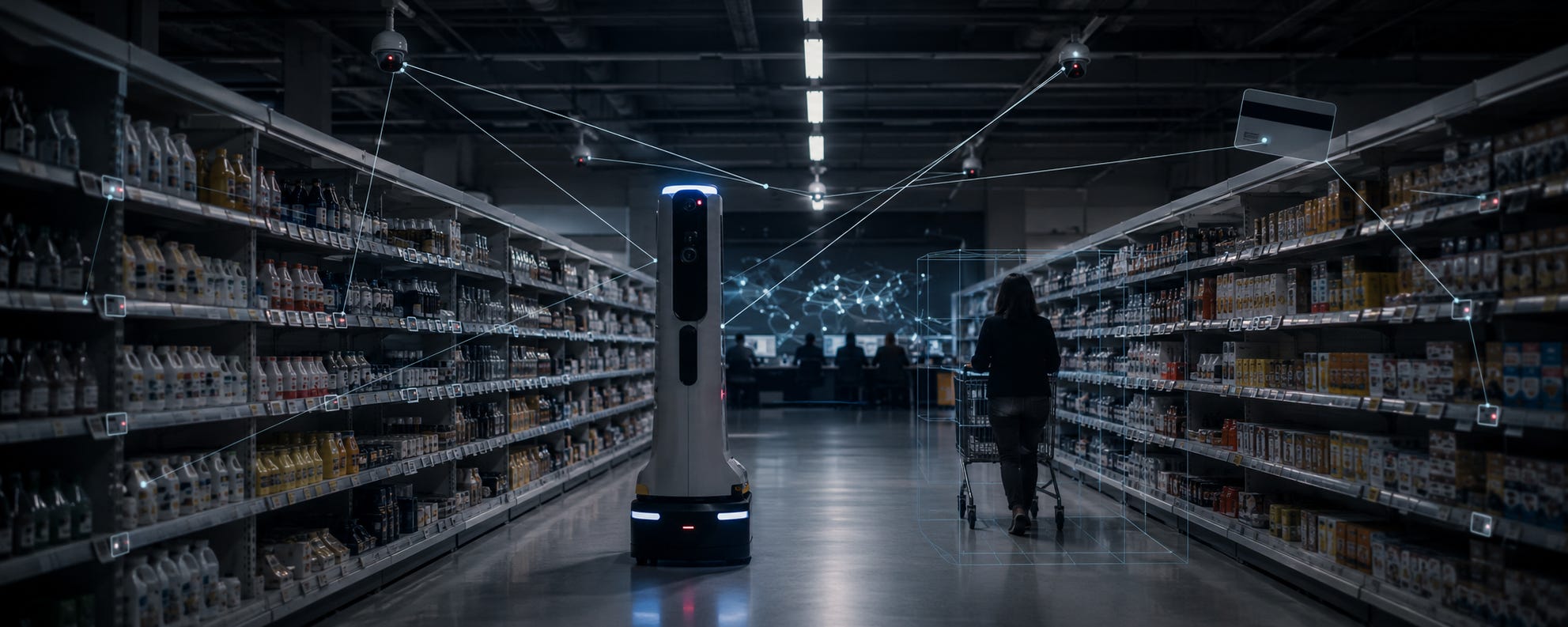
A routine trip to Kroger turned unsettling this week when a shopper encountered a six-and-a-half-foot autonomous robot patrolling the aisles. What initially appeared to be a simple inventory machine raised questions that led far beyond missing merchandise and incorrect shelf prices—into one of the largest and least transparent consumer-data operations in American retail.
The robot appears consistent with Kroger’s expanding tests of autonomous inventory scanners. The company has piloted machines such as Simbe Robotics’ Tally and another robot nicknamed Barney, reportedly produced by Badger Technologies. These robots travel through aisles repeatedly, using cameras, sensors, and image-recognition technology to identify empty shelves, misplaced products, inventory shortages, and pricing errors. In 2025, Kroger was reported to be testing the systems across approximately 70 stores in the Cincinnati and Indianapolis markets. Grocery Dive
Inventory management, however, may be only the most visible layer of Kroger’s technological infrastructure.
Kroger’s privacy policy acknowledges that biometric information—including facial-recognition data—may be collected at select locations for security, safety, fraud prevention, and the investigation of shoplifting or other criminal activity. Kroger says notices are posted at entrances where such collection occurs. At the same time, company representatives have denied allegations that facial recognition is being used in connection with individualized or “surge” pricing. Those are not identical claims, but the distinction has often remained unclear in public discussions. Kroger Privacy Policy
That ambiguity drew congressional attention. Representative Rashida Tlaib questioned Kroger about facial-recognition technology and whether electronic shelf labels could eventually enable discriminatory or dynamic pricing. Kroger has maintained that it does not engage in surge pricing and that its electronic shelf-label programs are intended to improve efficiency and lower prices—not personalize increases according to the shopper standing nearby. CBS News Detroit
The deeper concern lies with 84.51°, Kroger’s wholly owned data-science and retail-media operation. The division says it draws insights from shopping activity associated with more than 62 million American households, allowing Kroger and participating brands to analyze purchasing behavior both online and inside stores. 84.51°
A 2025 Consumer Reports investigation found that Kroger’s customer profiles can incorporate information obtained from outside data providers and include modeled assumptions about income, education, ethnicity, lifestyle, and health-related characteristics. These are not necessarily facts supplied by customers. They can be algorithmic inferences drawn from purchases, demographics, and third-party information—and they can be profoundly inaccurate.
Oregon shopper Hazem Salem used the state’s privacy law to obtain a 62-page copy of his own Kroger profile. According to the investigation, many of its conclusions—including details about his gender, education, income, and shopping loyalty—were wrong. The case revealed not only how much information can be assembled around a routine grocery account, but how confidently an automated system can mischaracterize the person behind it. Consumer Reports
Kroger has told investors that third parties do not receive identifiable customer data through its media and consumer-insights businesses. Yet critics argue that this assurance does not fully resolve the larger concern: Kroger still combines purchase histories, loyalty accounts, predictive analytics, outside information, retail advertising, store cameras, and increasingly automated monitoring systems within the same corporate ecosystem. Kroger SEC disclosure
None of that proves that the aisle robot itself is identifying customers, reading faces, or determining what an individual shopper will pay. The publicly documented purpose of Tally and Barney is inventory and pricing accuracy.
What remains publicly unconfirmed—but has been described independently to Strike Force News by a security-industry source—is the extent to which Kroger’s camera, biometric, inventory, loyalty, and analytics systems may already feed into a unified, real-time surveillance infrastructure.
Kroger has not publicly addressed that specific integration claim.
That is the question standing in the aisle beside the robot: not simply what the machine can see, but where the information goes, what it may be combined with, who can act upon it—and how much the person pushing the shopping cart will ever be permitted to know.
#Kroger #RetailSurveillance #ConsumerPrivacy #FacialRecognition #BiometricData #DataBrokers #ArtificialIntelligence #SurveillanceTechnology #DigitalPrivacy #ElectronicShelfLabels #StrikeForceNews